UNICORN778 Interview with Venezuela’s guardian of morichales Peluang Terburuk Saat Bermain Slot Online
- Morichales, ecosystems which consist of the moriche palm (Mauritia flexuosa), regulate freshwater bodies and rank among the ecosystems with the greatest carbon sequestration capacity (up to 590.8 metric tons per hectare).
- The ecosystem and culture of the Warao people, who consider the palm their “tree of life,” are facing serious pressures due to urbanization, industry and weak protection laws.
- Miguel Ángel Sánchez-Mercado, a Venezuelan biologist and professor, spoke to Mongabay about his research on this species.
- He advocates for an integrated approach to science that combines biological research with ethnographic work in communities, fostering a collective awareness in which human beings play an active role in the solution.
While global climate conversations tend to center on the Amazon and temperate forests, a vital, quiet freshwater oasis across the Venezuelan savannas and floodplains is disappearing under the radar. Standing tall in these landscapes is a palm intrinsically linked to the culture of Latin America’s Indigenous peoples, a palm whose unique physiology regulates freshwater bodies and conceals a massive, overlooked potential for climate change mitigation: the moriche palm (Mauritia flexuosa).
This species forms dense ecosystems known as morichales, dominating the landscapes of the Eastern Llanos and the Orinoco Delta in Venezuela, with its presence stretching across the Neotropics. Studies conducted in the Colombian Altillanura show that morichales are capable of capturing 590.8 tons of carbon per hectare, positioning them among the ecosystems best adapted to capture carbon in soil and biomass.
Yet, the moriche palm faces mounting pressures. Standing on the frontline of its defense and conservation is Miguel Ángel Sánchez-Mercado, a Venezuelan biologist, professor and researcher at the Universidad Bolivariana in Maturín, Monagas state. For him, conservation should strive to build a profound collective awareness of the ecosystem. His ultimate hope, after countless sunrises in the morichales, is the continued fight to preserve these ecosystems by fully integrating human beings as an active part of the solution rather than merely treating them as a threat to these invaluable guardians of the climate.

Mongabay interviewed Sánchez-Mercado to gain a deeper understanding of the challenges and opportunities associated with the conservation of Mauritia flexuosa, as well as what makes these palms unique.
The following interview was translated from Spanish and edited for length and clarity.
Mongabay: Morichales are ecosystems featuring a high concentration of moriche palms. What other characteristics define these ecosystems?
Miguel Ángel Sánchez-Mercado: Morichales are classified as hydrophilic forests associated with palm groves. They are forests with a condition of almost permanently saturated humidity and soils. These ecosystems depend on water runoff, but this runoff does not need to be of high volume; rather, the water flow must be slow. That is why most morichales originate in what we call ‘water eyes’ [natural springs where groundwater wells up] and effluents of larger water bodies.
They are typical Neotropical ecosystems, and we can find them in Brazil, Colombia, Peru, Ecuador and Venezuela. Their distribution is so broad that their names even change. For example, in Brazil they are called buritiales. Here, between Colombia and Venezuela, they are called cananguchales and morichales proper, depending on where you are standing. If you go toward the Llanos region, you will find people who call it morichal rather than cananguchal.
In Venezuela, they are found in nine states. In Cojedes, Sucre, Anzoátegui, Bolívar … but Monagas is the state with the highest percentage of this ecosystem. In Maturín [the capital of Monagas], we live surrounded by morichales, and it is a city that can be considered privileged in that sense, because it has plenty of them, and very well preserved, especially toward the southern zone.

Mongabay: In your studies and findings, you have called the moriche palm the ‘best warrior against climate change.’ Why? What advantages does it offer for reducing the amount of carbon dioxide in the atmosphere?
Miguel Ángel Sánchez-Mercado: We are working on a fairly broad project to verify the effectiveness of carbon sequestration and better understand the dynamics of the carbon cycle in morichales. The intention is to be able to contrast the results with other ecosystems and their capacities to capture carbon from the environment.
Another ecosystem famous for its capacity to capture carbon from the atmosphere is mangroves. The particular difference between the two is that a mangrove is only found at the coast; precisely, it depends on a salinity cycle that the morichal does not have. On the other hand, the advantage of the morichal is that you can easily replicate the ecosystem anthropically in another location. As long as you stay within the tropical belt, you can replicate the ecosystem as a way to manage carbon mitigations and preserve water sources. These are just some of the many possibilities, and it is what we are trying to carry out in the project [known as Morichales: Potencial como Sumideros de Carbono or Morichales: Potential as Carbon Sinks] to describe it very surgically.
Mongabay: How does the moriche palm help protect water bodies?
Miguel Ángel Sánchez-Mercado: Let’s say it is a codependent system; one of the reasons the morichal exists is because the water affluent exists, and vice versa. Biologically, the plant does a fundamental job: Its roots penetrate the earth to retain groundwater and control soil erosion, acting like a large sponge that absorbs water during the rainy season and releasing it drop by drop during droughts. Thanks to that, the plant directly contributes to preserving the ecosystem and water sources as such.
That is why most morichales establish themselves in what we call ‘water eyes’ or slow-flowing effluents. And to achieve this protection, the morichal relies heavily on its bordering ecosystems: On one side exists the savanna, and on the other side the transitional forest zone. On one bank and the other… and in the middle, the morichal protecting the water basin.

Mongabay: Besides its ecological advantages, what other benefits does the moriche palm offer to surrounding communities?
Miguel Ángel Sánchez-Mercado: In Colombia, Peru and even Brazil, there is production of the palm. It is replicated anthropically so that they can harvest part of the fruits, which are highly valued internationally. The fruit pulp is very well valued abroad because it is widely used in cosmetics and food, especially in food. The substitute for ice cream, the base of ice cream, is now sold by Colombians and Peruvians as moriche palm fruit pulp.
By contrast, here in Venezuela, nobody has set out to say, ‘Let’s produce things based on the moriche palm.’ Here it is just an item sold by the Indigenous people, but nothing more. Colombians have had a long head start on us in that; not to mention Peruvians, who have a lifetime of experience in it.
Mongabay: Is the rest of the palm usable?
Miguel Ángel Sánchez-Mercado: Yes, of course. The Warao [the second-largest Indigenous people in Venezuela] make use of everything from it. They call the palm ojidú (spelled with a ‘j’). That means ‘tree of life’.
They make flour from the trunk and obtain protein from the grubs living inside the palm. The fruits serve as food and to prepare beverages. They also use the plant fibers to weave baskets and handicrafts, as well as their chinchorros [typical hammocks]. With the leaves, they build the roofs of their houses, and with the wood, they build the canoes they use to travel across rivers and channels. Furthermore, the moriche palm holds a special value in the cosmogony of the Warao people.
However, all of this has fractured, very lamentably. Many of the Warao have been displaced and have acculturated into more urban or opportunistic contexts. Many have been forced to abandon their culture and turn to other things in order to survive.

Mongabay: If the ‘tree of life’ is at risk for the Indigenous communities that depend on it to subsist, the macroecological outlook must be equally concerning. What other major environmental or industrial challenges are putting the survival of morichales in Venezuela against the wall?
Miguel Ángel Sánchez-Mercado: The displacements here in Maturín due to urbanization conditions have significantly affected morichales. There are areas where morichales previously existed and they displaced them solely to build houses; that is lamentable. Especially because morichales are part of Venezuela’s ABRAE (Areas Under Special Administration Regimes), so you cannot displace an ecosystem like that just because. But this is one of the major weaknesses of this ecosystem, it is legislatively very weak. The protection of morichales dates back to 1991 with Decree 846 by Carlos Andrés Pérez, but nothing more has been done besides that decree with two articles, which simply protects the morichal up to 300 meters [985 feet] from the adjacent strip where no type of construction is allowed. Of course, this legislation is not always respected.
At the industrial level, there is also a problem with what oil companies call ‘environmental liabilities.’ Companies think that the high resilience a morichal possesses exempts it from reforestation efforts. When there is a spill, it is easier to take remediation measures for the water body, but they forget that the morichal is part of that biological web. So, they try to recover the river, but they do not recover the morichal. This inevitably affects the water basin, even if there is an intention to clean it up.

Mongabay: In your teaching and research work, you have advocated for ‘socioconservation’ as a response to the problems facing morichales. What does this approach consist of?
Miguel Ángel Sánchez-Mercado: Here at the university, we run the environmental management program, and one of the things I teach, through practice and research, is how to integrate yourself into living with the ecosystem. You can work in harmony with the ecosystem, but you have to learn to coexist with it. When you do not know someone, you do not know their ways; maybe they are more finicky, they do not like to wake up early, they like their coffee a certain way. With an ecosystem, it is the same. You have to respect its natural cycles and coexist with it. The problem is that we interfere and are not conscious of that interference; when we learn to be conscious of that interference, the integrity of this partner becomes more evident, more tangible.
That is why we work directly with communities. We conduct environmental assessments; we gather ethnographic data that goes hand in hand with the raw data of what we are doing. That is what I call integrated science, because natural sciences and social sciences can be integrated.
I can specify that we have worked with more than 16 communities, all of them here in Monagas. Through this, I realized that people lack awareness of the morichal. That is why what I want to do is create a collective awareness about the morichal so they understand they can preserve something that will be useful to them.
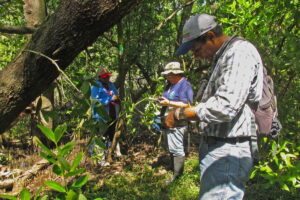
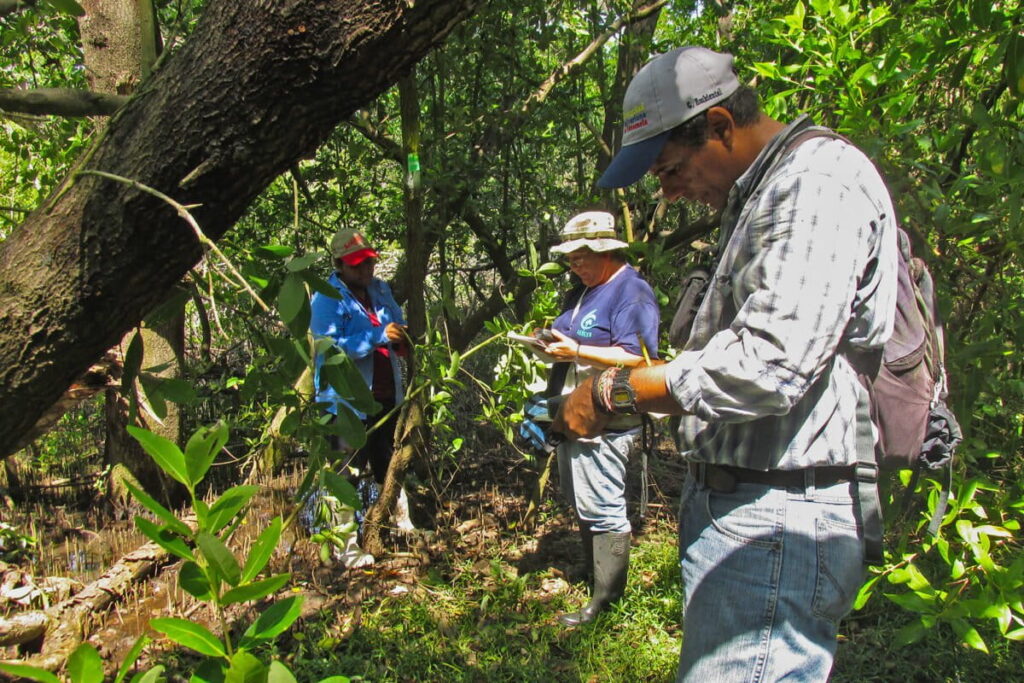
Banner image: Miguel Angel Sánchez-Mercado on a field trip. His research evaluates the dynamics of morichales, as well as their potential as carbon sinks that can be easily replicated in the tropical belt. Image courtesy of Miguel Angel Sánchez-Mercado.
Cite this article
Diego Ávila Muskus (2026). Water, carbon & the ‘tree of life’: Interview with Venezuela’s guardian of morichales. Mongabay Conservation news. DOI: https://doi.org/10.66709/news-333540