UNICORN778 Interview with botanist Brett Wilson Peluang Terburuk Saat Bermain Slot Online

- A massive genetic analysis of wild tulips has confirmed that Central Asia is the birthplace of tulips, but no single country can rightfully claim the flower originated within its borders.
- The researchers of the study also traced the closest ancestors of the popular garden tulips down to two possible candidates, Tulipa suaveolens and T. scardica.
- Brett Wilson, the study’s lead author and co-founder of the IUCN SSC Wild Tulip Specialist Group, told Mongabay that “urgent action is needed … if we are not going to lose a great many of these species.”
- More than half of all wild tulips assessed on the IUCN Red List are threatened with extinction.
The universally beloved tulips are synonymous with the Netherlands. The low-lying European country dominates the global market, producing nearly 90% of the world’s tulips. Every year, from March to May, tourists flock to tulip gardens and fields in the Dutch countryside to see the flowers in full bloom.
The origins of Tulipa, however, are believed to lie elsewhere.
A massive genetic analysis of wild tulips has confirmed that broader Central Asia is the birthplace of tulips, dating back roughly 32.5 million years. The researchers also traced the closest ancestors of the popular garden tulips down to two possible candidates.
This study “is a foundational piece of our understanding of the [Tulipa] group,” study lead author Brett Wilson, co-founder of the IUCN SSC Wild Tulip Specialist Group, told Mongabay by email.
“We now know — rather than assume — that tulips originated in Central Asia, and that urgent action is needed there if we are not going to lose a great many of these species.”
Wilson, a botanist and conservationist whose Ph.D. research was focused on tulips at the University of Cambridge, U.K., spoke with Mongabay’s Shreya Dasgupta about the new study.
The following interview has been edited for length and clarity.

Mongabay: It’s been generally believed that tulips originated in Central Asia. Why is this study important now?
Brett Wilson: Central Asia has always been the obvious suspect — it holds more wild tulip species than anywhere else on Earth — but “obvious” is not the same as “demonstrated,” and nobody had ever properly tested it. Ours is the first study with enough of the genus in hand to do that: Plastid genomes [DNA contained within cell organelles like chloroplasts] from 254 specimens covering roughly 86% of all known tulip species, about double the coverage of any previous DNA study. The answer is unambiguous.
Tulips are Central Asian, and the ancestor of every tulip alive today — including the ones in your local park — traces back to an ancestor that arose there around 32.5 million years ago.
Much of our material came from expeditions between 2019 and 2021 across Kyrgyzstan, Tajikistan and Uzbekistan, working with national academies of science and botanic gardens, and with [conservation nonprofit] Fauna & Flora in Kyrgyzstan. Fieldwork on that scale simply was not possible a generation ago — and the flora is still being written: One of the plants in our sampling, T. toktogulica, was discovered new to science during the project.
And we are running out of time. Of the 53 Central Asian tulips assessed on the IUCN Red List, 27 are already threatened with extinction — five critically endangered, seven endangered and 15 vulnerable — with a further 14 near threatened. That is over half the region’s assessed species at risk, concentrated in the Tien Shan and Pamir-Alay [both massive mountain systems in Central Asia], the single richest tulip region anywhere on Earth.

Mongabay: What did fieldwork look like?
Brett Wilson: Most of mine was in Kyrgyzstan, a country of mountains, winding tracks and rural farms. Every expedition began in Bishkek with shopping and logistics, where the team would gather: Fauna & Flora, myself and colleagues from the National Academy of Sciences [of Kyrgyzstan], led by the wonderful Professor Kaiyrkul Shalpykov. Then we would head into the mountains for anything up to 10 days, crossing high passes, checking known populations and, now and then, gambling on a valley nobody had surveyed. The routine was simple: Pile out of the car, fan out across the slope hunting for those unmistakable flashes of color, and ask any shepherd we met whether they had seen the plant. Sometimes we struck gold and sometimes we were less lucky. Inside protected areas tulips sometimes carpeted the ground, but far more often we found them on pastureland or on a roadside verge in small populations.
Meanwhile, collaborators were doing the same work in Uzbekistan, Tajikistan (I joined an expedition there one year), Türkiye and the Balkans, which is how a genus this widespread gets covered at all.
Mongabay: Did you find any of your results regarding where Tulipa originated particularly surprising?
Brett Wilson: Yes — and the most interesting result cuts straight across modern geopolitics. Several Central Asian countries claim the tulip as their own; Kazakhstan in particular has claimed to be its birthplace. What our tree [of tulip evolutionary history] shows is that no single country can own this story. When the ancestor of all tulips appeared, none of these borders existed, and the landscape looked nothing like it does today. We also cannot rule out western China and Mongolia as part of the origin story because the two earliest-branching lineages — subgenus Orithyia and Eduardoregelia, the new subgenus we describe in this paper — trace back to the Far East. Broader Central Asia is the answer; a single pin on a modern map is not.

Mongabay: Your study found that Tulipa suaveolens and T. scardica are likely the closest relatives of the earliest garden tulip cultivars. Was this surprising, and what is the implication of this finding?
Brett Wilson: It genuinely was. The story everyone tells is that garden tulips came out of the Ottoman and Persian empires, so you would expect their wild ancestors to be Turkish, Iranian or Central Asian. Instead, the closest wild relative of Duc van Tol — grown in the Netherlands since 1595 and one of the oldest cultivars still in cultivation anywhere — is Tulipa suaveolens, a scented steppe species ranging across eastern Europe, Russia and Kazakhstan. It is very likely one of the maternal ancestors of T. ×gesneriana, the complex hybrid behind essentially every modern garden tulip. The second species, T. scardica, grows in the Balkans, pointing to southeastern Europe as another important source of early breeding stock.
Mongabay: The study also notes there may be other species that contributed to the first cultivars. Why is it so challenging to identify the roots of garden tulips?
Brett Wilson: The tulip is one of the most intensively bred plants in history and one of the worst-documented — we are effectively doing forensics on a crime scene that is now over five centuries old.
Start with the escapes. Tulips have a long history of hopping the garden wall and establishing “wild-looking” populations well outside their native range. Telling a genuinely wild population from a 400-year-old garden escape is one of the hardest calls in the whole genus.
Then stack three more problems on top. First, human hands: Bulbs have been carried along trade routes for the best part of a millennium, so today’s distributions are a poor guide to natural ones. Second, there was almost certainly no single founding parent, but a whole cast of species crossed and re-crossed over centuries — which is why the candidate list narrows rather than resolves. Third, sampling: Some of the most important regions are the hardest to work in. Iran is difficult, and now Russia and Ukraine too, which leaves gaps precisely where some of the answers lie.
And finally, the biology. Tulips are all extremely closely related, so pulling them apart genetically has historically been very hard indeed.

Mongabay: How are tulips doing in the wild?
Brett Wilson: There are 62 wild tulip species assessed on the Red List, and the great majority — 53 — are Central Asian.
Of the species assessed so far, 32 are threatened. So more than half of the wild tulips we have managed to assess are already at risk of extinction. For a flower this famous, it may surprise people how rare its wild relatives have become.
Mongabay: What are the major threats to wild tulips?
Brett Wilson: The two threats that come up again and again are livestock overgrazing and climate change. Grazing pressure hits tulips directly — bulbs trampled, flowers eaten before they can set seed — and a warming, drying climate is squeezing mountain species upslope with nowhere left to go while more unpredictable weather can lead to landslides and floods.
Then there are threats that are devastating for particular species rather than the genus as a whole: Mining, infrastructure development, and overcollection of bulbs from the wild. For a narrow-range endemic sitting on a single hillside, any one of those can be an extinction event on its own.

Mongabay: Is overcollection of tulip bulbs from the wild a big threat to species? And are there tulip species that are rare in the wild but abundant in nurseries or botanic gardens?
Brett Wilson: Overcollection hits a small number of species hard. The classic victims are the big, showy red-flowered species growing close to settlements: Tulipa fosteriana in Uzbekistan and Tulipa praestans in Tajikistan have both been collected heavily, and both are now assessed as vulnerable on the IUCN Red List.
The good news is that we see no large international trade in wild-collected tulips. Commercial breeding runs almost entirely on cultivar material. We do note some wild material collected in recent years, possibly entering breeding without clear permits, but this is small-scale and driven by tulip fanatics rather than industry. More than half of Central Asian wild tulip species are now assessed as threatened with extinction — that is the number to keep in mind.
And to the second half of your question — there is a real irony here. Some of the species most depleted in the wild are the ones you can buy by the barrowload. Tulipa greigii, T. kaufmanniana and T. fosteriana are the wild ancestors behind entire garden tulip groups, sold in their millions every autumn, while their wild populations in Central Asia are declining and their historic range is substantially depleted. Abundance in a nursery or a botanic garden tells you nothing about whether a species is still holding on in the wild.
Mongabay: For species rare in the wild, do cultivated individuals count toward the species’ population, and can they be introduced into the wild again?
Brett Wilson: Plants in collections absolutely do count towards a species’ overall survival prospects; they are one of our best insurance policies against extinction. But usually when we measure a population, we count wild individuals in natural habitat, because those are the plants established, reproducing and surviving in nature. The goal is always self-sustaining wild populations.
The complication is hybridisation. Tulip cultivars and wild species cross-breed happily in nurseries and collections, producing genetic combinations that never occurred in nature, and we must not release that into the wild. Where hybridisation can be ruled out, there is no reason we cannot reinforce wild populations with collection-grown plants, which is exactly why we have been building up ex situ collections in botanic gardens across Kyrgyzstan, Tajikistan, Kazakhstan and Uzbekistan as well as places like Cambridge University Botanic Garden, the Royal Botanic Gardens, Kew, and Gothenburg Botanic Garden, so that restoration becomes possible for species that have vanished from sites or whose populations need a hand. For the very rarest species, those collections are priceless.
Reintroduction still has to be done carefully: No hybrids, good survival rates for bulbs and seed, and only into places where the original threats have actually been reduced.
In short: Keep the cultivated collections, treasure them, and use them — but the measure of success is tulips thriving on their own in the wild.

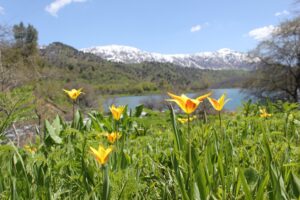
Banner image: Tulipa anadroma, a threatened tulip species, growing in the Sary-Chelek Biosphere Reserve in western Kyrgyzstan in early 2019. This protected area is the only place on Earth where the species can be found. Image by Brett Wilson.
Citation:
Wilson, B., Christenhusz, M. J., Walker‐Hale, N., Beshko, N., Boboev, M., Clubbe, C., … Brockington, S. F. (2026). Phylogenomic insights into the genus Tulipa (Liliaceae): Taxonomy, evolution, and biogeography. American Journal of Botany, e70232. doi:10.1002/ajb2.70232