UNICORN778 Can an ancient European forest be saved while securing Poland’s border? Peluang Terburuk Saat Bermain Slot Online
Straddling the border between Poland and Belarus, the ancient Białowieża Forest, one of Europe’s last remaining primeval woodlands, is already under stress from decades of drainage, drought and habitat fragmentation.
As geopolitical tensions and security threats from Russia and Belarus rise, Poland plans to construct a massive network of military fortifications along its 700-kilometer (435-mile) eastern frontier through the “East Shield” initiative launched in 2024. However, conservationists say the initiative, which would involve constructing traditional concrete bunkers, minefields and anti-tank ditches through the UNESCO World Heritage site, would cause severe destruction to local wildlife, reports contributor Marta Kasztelan for a Mongabay video.
To prevent widespread habitat destruction, scientists from the Polish Academy of Sciences proposed an alternative strategy known as “warwilding” — restoring dense forests, rivers and bogs to serve as natural physical barriers against heavy military vehicles.
“Places like this are very important because a tank can’t get through. So, if we expect an attack from that side, then we should preserve this type of environment,” Michal Zmihorski, a conservation biologist with the Polish Academy of Sciences, says in the video.
To the researchers’ surprise, Poland’s military leadership embraced the proposal and incorporated ecological recovery into its border defense plans. “Our position is that the construction of the ‘East Shield’ and environmental protection can go hand in hand,” says Marek Pietrzak, a spokesperson for the Polish Armed Forces. He notes that natural terrain can actively stall advancing forces, adding that “the landscape can put up a fight.”
Although Polish authorities earmarked $120 million in European Union funding for nature-based defense projects, progress on the ground remains slow and relies heavily on volunteers and conservation groups, according to Zmihorski. Over decades, more than 700 kilometers (435 miles) of drainage ditches and regulated rivers turned once-impenetrable swamps into dry, walkable land, threatening native ecosystems.
Conservationists with non-governmental organizations like the Polish Association for Bird Protection (PTOP) are working to rewild local waterways to retain vital groundwater. “I think that protecting the forest can be compatible with national security, especially in this area,” says Edyta Kapowicz, a conservationist with PTOP. “What we do helps our country’s defense.”
Conflicting local development projects, including widening a portion of the 2,000 kilometers (about 1,243 miles) of roads running through the forest, threaten to undermine natural barriers. Zmihorski notes that immediate action is necessary to reverse water loss and secure the region.
“We must act drastically, in terms of scale and pace. It’s not like we can ponder this for another five years … because the geopolitical situation is very uncertain,” Zmihorski says.
Watch the full video by Mongabay here.
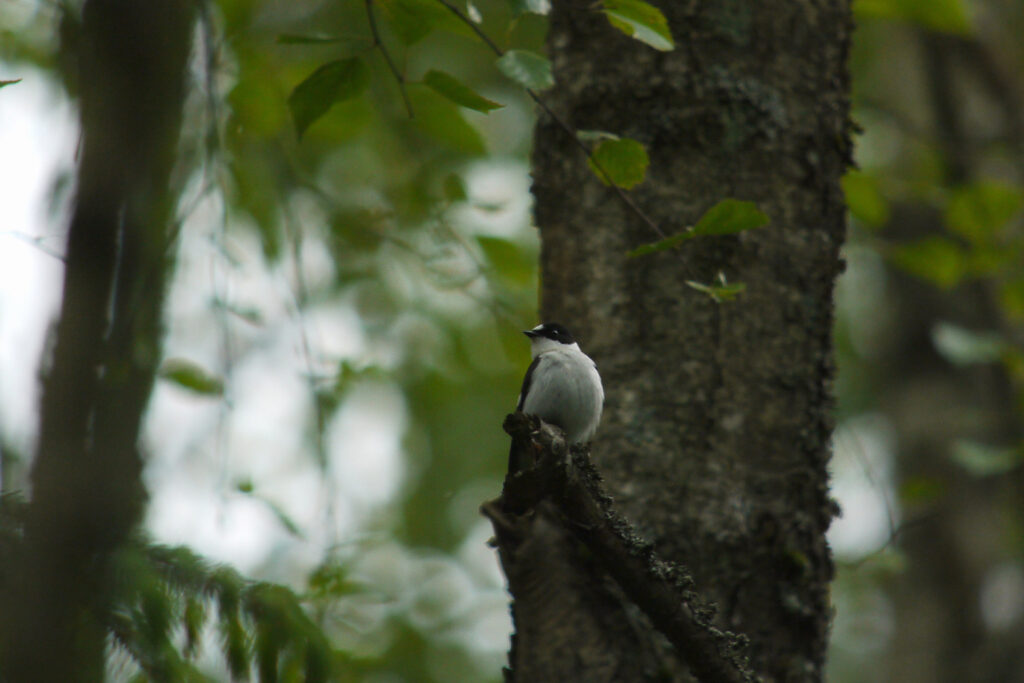
Banner image: A collared flycatcher (Ficedula albicollis) in Białowieża Forest. Image by Frank Vassen via Wikimedia Commons (CC BY 2.0).