UNICORN778 Mozambique safari operator wins conservation award at COP17 Peluang Terburuk Saat Bermain Slot Online
YEREVAN, Armenia — A Mozambican safari operator credited with helping restore wildlife populations in Mozambique’s Zambezi Delta, has won the 2026 Markhor Award, which recognizes contributions to conservation through sustainable wildlife management.
Zambeze Delta Safaris, led by professional hunter Mark Haldane, received the award on Oct. 22, 2026, at the ongoing U.N. Biodiversity Conference, COP17, in Yerevan, Armenia. The company combines regulated trophy hunting with wildlife restoration, anti-poaching efforts and community development in an area of Mozambique that was devastated by the country’s civil war.
“There is no other way to describe it than it’s a truly humbling feeling,” Haldane told Mongabay in a WhatsApp interview. “In my wildest dreams I never imagined this or anything close to this.”
The award comes as governments at COP17 review progress toward global biodiversity targets adopted in 2022. One of them, Target 9, calls for sustainable wildlife management that also benefits communities. A new U.N. assessment warns that the world remains off track to meet its biodiversity commitments by the 2030 deadline.
Astrid Schomaker, executive secretary of the Convention on Biological Diversity (CBD), welcomed the recognition. “Here is something we can celebrate,” she said during a press conference announcing the winner.
Haldane began working in Coutada 11, a hunting concession in central Mozambique, in 1994, after years of conflict had severely depleted wildlife populations. He later established Zambeze Delta Safaris with Mozambican businessperson Carlos Pacheco Faria.
According to the company’s award nomination, since the safari outfit began working in the region, the African buffalo (Syncerus caffer) population has risen from about 1,100 to 35,000, while sable antelopes (Hippotragus niger) have increased 100-fold from just 40 to 4,000. Twenty-four lions (Panthera leo) were reintroduced in 2018, roughly 120 live there now. Mongabay has not independently verified all the figures, although Mozambique’s Foundation for the Conservation of Biodiversity has documented substantial wildlife recovery.
Trophy hunting remains controversial though amid questions about who benefits. A 2013 study conducted in Mozambique’s Niassa National Reserve, for example, found that a single leopard could generate approximately $24,000 in hunting revenue, however little of that money went back to local communities.
More recently, however, a 2026 review of 89 studies across 13 sub-Saharan African countries found that nearly two-thirds of documented trophy-hunting “outcomes were positive,” for either wildlife or local people.
Haldane told Mongabay that Mozambique’s law directs that 20% of government revenue collected from concessionaires, like him, to be paid to local communities. He said the money goes to community-nominated committees and is used to fund projects benefiting residents.
Established in 2008, the Markhor Award is presented every two years. Previous winners include conservation initiatives in Tanzania, Namibia, Zimbabwe and Iran.
Looking ahead, Haldane hopes to expand conservation efforts beyond Coutada 11. “We are not islands in conservation,” he said. Reflecting on three decades of work, he added: “Look after nature and she will bounce back.”
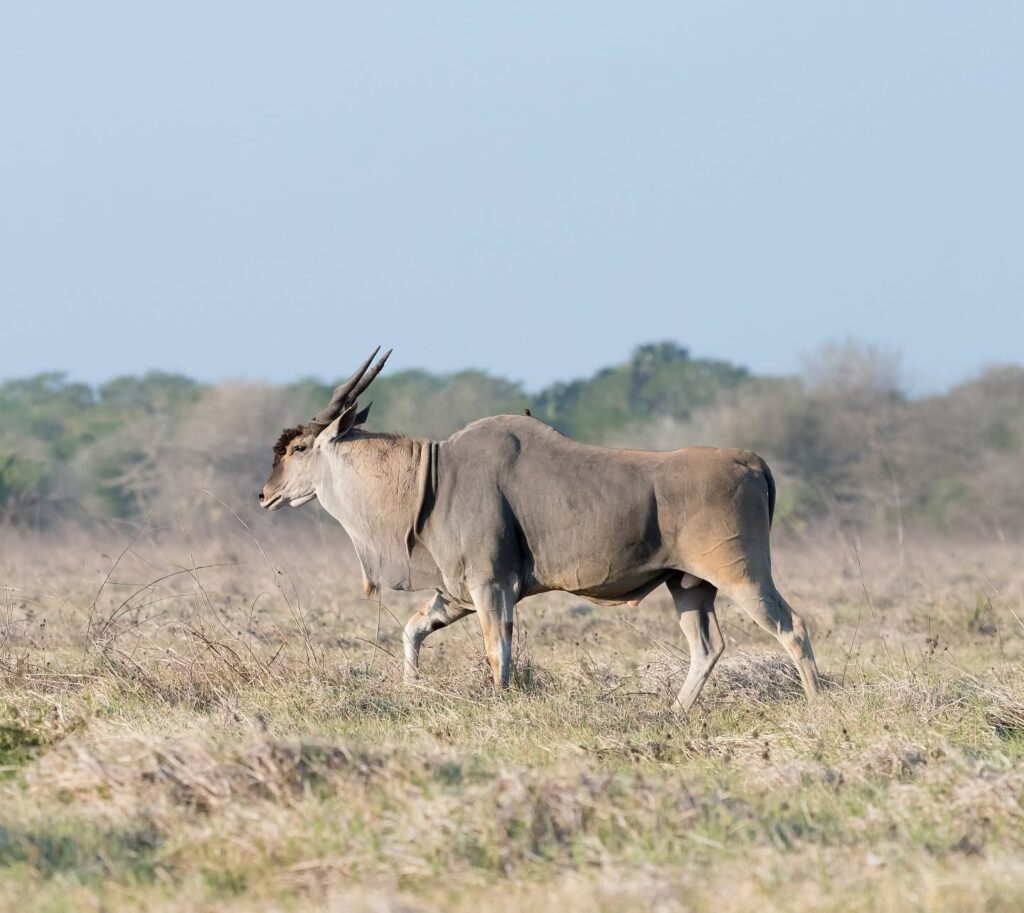
Banner image: A Livingstone’s eland (Taurotragus oryx livingstonii) bull in Coutada 11, Mozambique. Image courtesy of Zambeze Delta Safaris.